FAQ
Which drives are supported?
What is the meaning of error code xx/xx/xx?
I always get an error if I try to test a DVD Video.
What's the difference between CLV, CAV, P-CAV and Z-CLV?
The read/write speed of my drive is much lower than the rated speed
Which drives are supported?
The transfer rate, create test disc, verify test disc, drive info and disc info function work with all CD/DVD/BD drives.
The disc quality measurement functions work with following drives:
Disc Quality
BenQ
DW820, DW822, DW1600, DW1620, DW1640, DW1650, DW1655
Plextor
Premium, PX-712, PX-714, PX-716
Pioneer
DVR-103, DVR-104, DVR-105, DVR-106, DVR-107, DVR-108, DVR-109, DVR-110, DVR-111, DVR-112, DVR-113, DVR-114, DVR-115, DVR-116, DVR-117
NEC
ND-35xx (except ND-3500), ND-45xx
OptiArc
AD-71xx, AD-72xx
All LiteOn drives with a MediaTek chipset including but not limited to:
LiteOn
160H6S, 165P6S, LH-16xxx, LH-18xxx, LH-20xxx, DH-20Ax, iHASxxx, iHAPxxx, DH-4O1S, iHESxxx
Drives from other brands (for example Sony, Samsung) which use the MediaTek chipset are also supported.
CD Bler
BenQ
DW820, DW822, DW1600, DW1620, DW1640, DW1650, DW1655
Plextor
Premium, PX-712, PX-714, PX-716
FE / TE
LiteOn
160H6S, 165P6S, LH-16xxx, LH-18xxx, LH-20xxx, DH-20Ax, iHASxxx, iHAPxxx, DH-4O1S, iHESxxx
BenQ
DW1600, DW1620, DW1640, DW1650, DW1655
Plextor
Premium, PX-712, PX-714, PX-716
What is the meaning of error code xx/xx/xx?
Click
here
for a list of error codes and their explanation.
I always get an error if I try to test a DVD Video
This error occurs when you're trying to test a copy-protected DVD Video.
Playing the movie with a software DVD player will unlock the disc.
You can immediately shut down the DVD player after it started playing. The disc will remain unlocked until the computer is restarted or until another disc is inserted.
What's the difference between CLV, CAV, P-CAV and Z-CLV?
First it's important to know that, unlike hard disks, the data density on a CD is the same on every part of the disc. This means that there is more data on the outer part of the disc then on the inside.
CLV (Constant Linear Velocity)
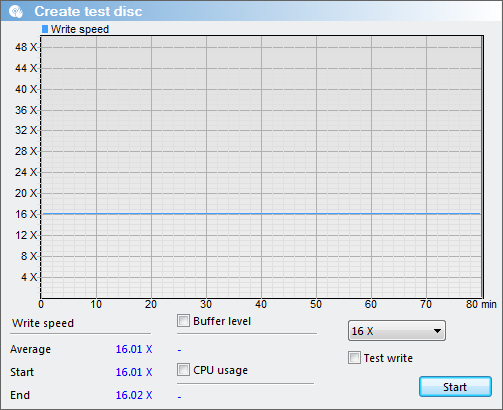
The data transfer rate is kept at a fixed level by changing the rotation speed.
CAV (Constant Angular Velocity)
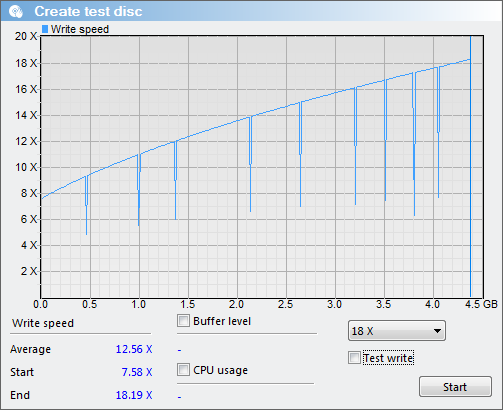
The drive maintains a consistent rotation speed which will result in a variable transfer rate.
P-CAV (Partial Constant Angular Velocity)
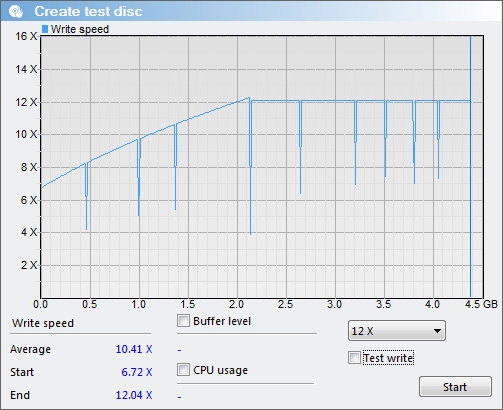
P-CAV is a combination of CLV and CAV.
The transfer rate increases until the drive reaches it's maximum speed (CAV). From that point the drive will slow down and the transfer rate will be constant (CLV).
Because P-CAV drives reach their maximum speed much sooner than CAV drives, the average transfer rate should be higher.
Z-CLV (Zoned Constant Linear Velocity)
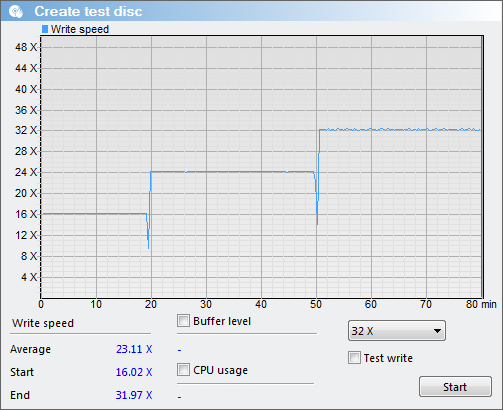
There are several CLV zones with this reading mode.
Important!
Most drives use different reading types. The reading type which is given in the specifications is the reading type of the
fastest
reading mode.
The read/write speed of my drive is much lower than the rated speed.
The most common cause for bad performance is an incorrect system configuration.
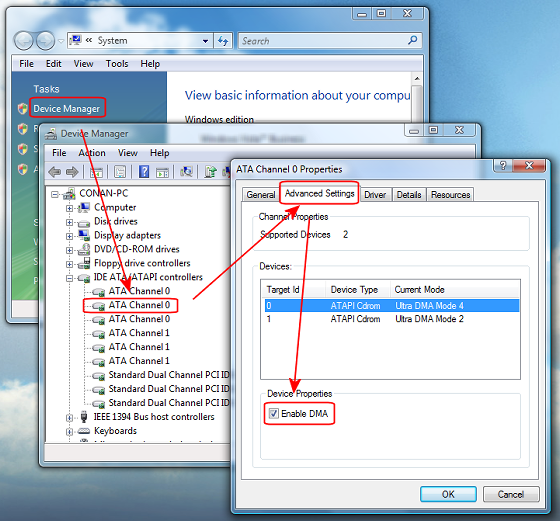
The most important setting for IDE or Atapi drives is the DMA setting. DMA or Direct Memory Access will dramatically reduce the CPU usage when transferring data. If a high speed drive does not use DMA then it will never reach it's rated speed and the performance will depend on the speed of the CPU.
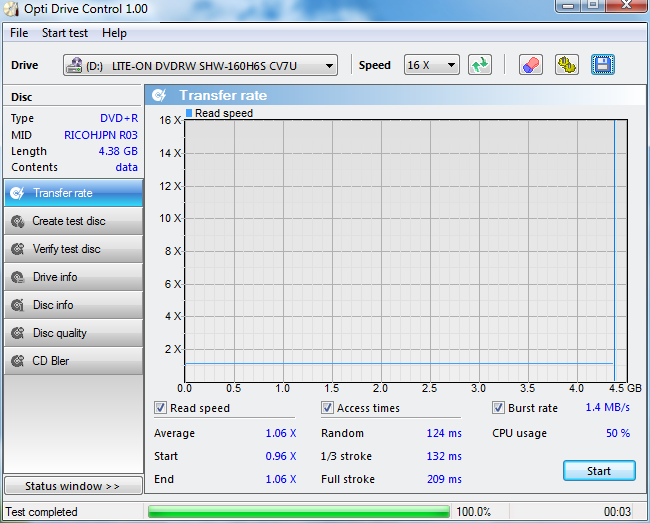
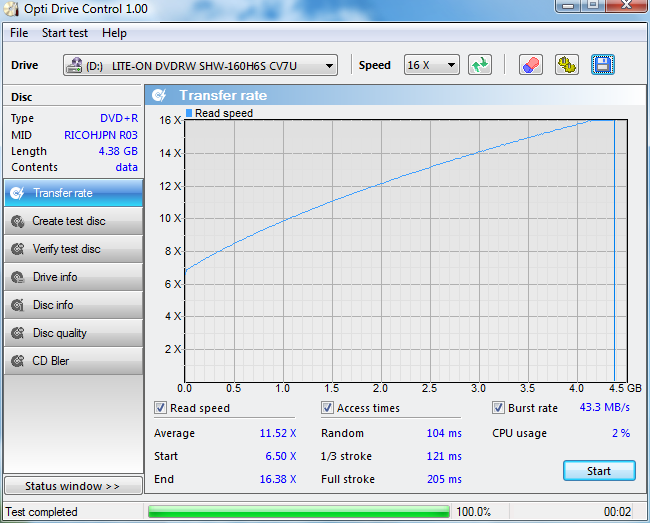
The graphs below show the performance of a drive with and without DMA enabled.
DMA disabled
Notice the low speed, low burst rate and high CPU usage.
DMA enabled
Tested with the same drive and disc but this time with DMA enabled.
You can check or change the DMA settings in Device Manager:
Copyright (c) 2009 by Erik Deppe